Today we're releasing Perceptron Mk1 (“Mark One"): a model purpose-built for video understanding and embodied reasoning, matching frontier performance at a fraction of the cost.
Mk1 is the first release in our new family of closed-source models. It delivers a step-change in image, video, and embodied reasoning that advances the capability frontier for physical AI and surpasses our open-source Isaac series across the board.
Built for the Physical World
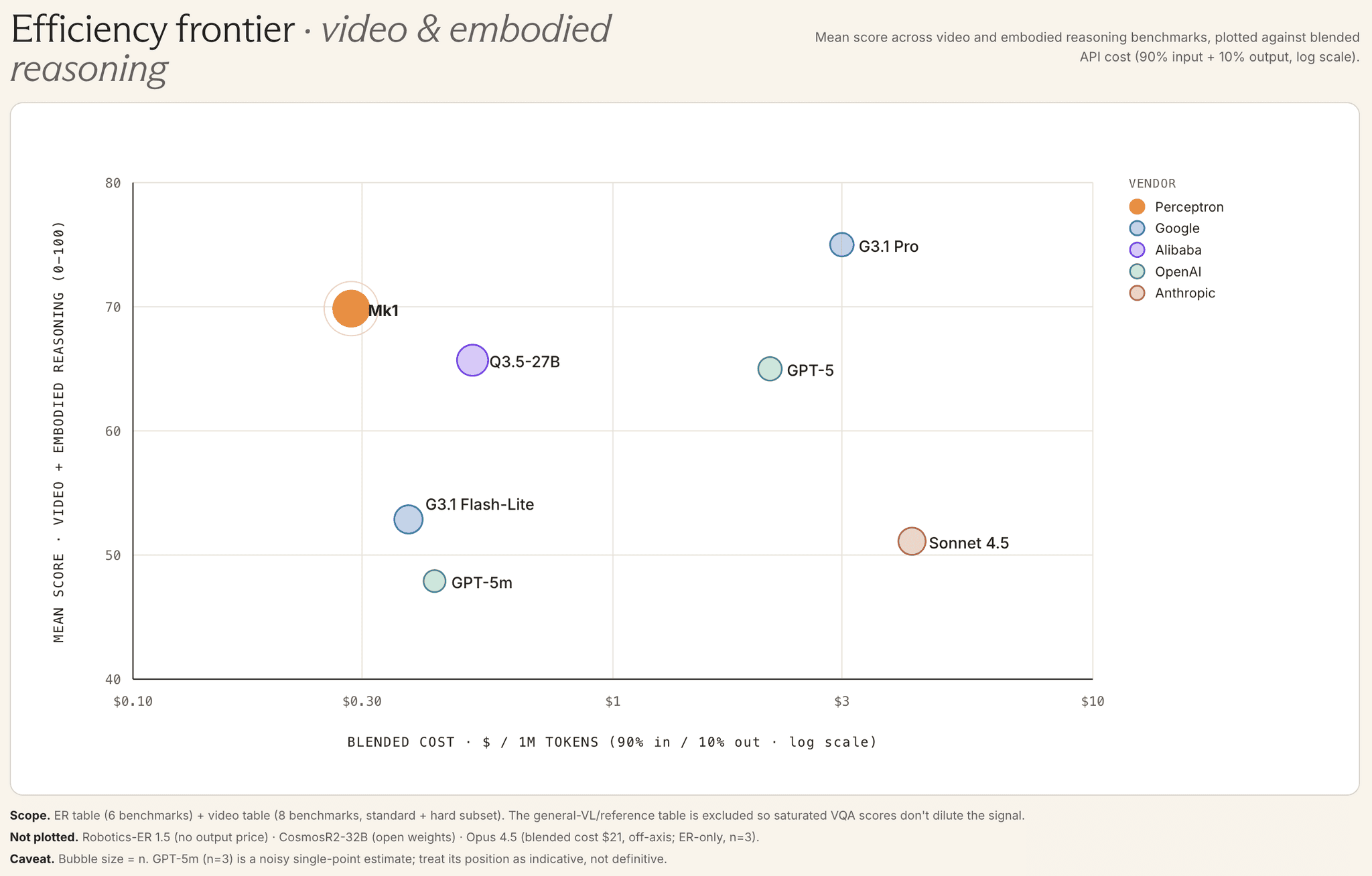
The physical world doesn't move in snapshots; it's a continuous stream of events. Mk1 is the perception and reasoning layer for that stream. It matches the image, video, and embodied reasoning capabilities of frontier models, including the Gemini Pro series, while achieving lower cost than Gemini Flash Lite ($0.15 per million input tokens, $1.50 per million output).
What’s New
Temporal Reasoning with Thinking Traces
Mk1 reasons across time. Given a sports broadcast or a cooking video, it doesn't just return a label. It considers every turn and every step before returning a structured breakdown of what happened and when. And as a hybrid reasoning model, Mk1 lets users turn reasoning off when it isn't needed.
Temporal Grounding with Video Clips
Mk1 analyzes video at a dynamic frame rate (up to 2 FPS) across a 32K-token context window. Ask for a specific moment in a long stream and the model returns structured timecodes you can act on. Mk1 can auto-clip grasp attempts in teleop episodes and flag restocking events in warehouses, all in a single prompt.
In-Context Learning and Multimodal Prompting
Show Mk1 a single reference image or video of what you're looking for and it will find every matching instance across new images and videos. Pass it two pieces of media, ask Mk1 to run a comparison, and it will return a side-by-side breakdown. No fine-tuning, no labeled dataset, no training pipeline. These capabilities collapse workflows for defect detection, asset tracking, and visual search into a single model call.
Advanced Image Reasoning
Much like our Isaac model family, Mk1 excels on image reasoning, while pushing further on capabilities production vision pipelines actually need:
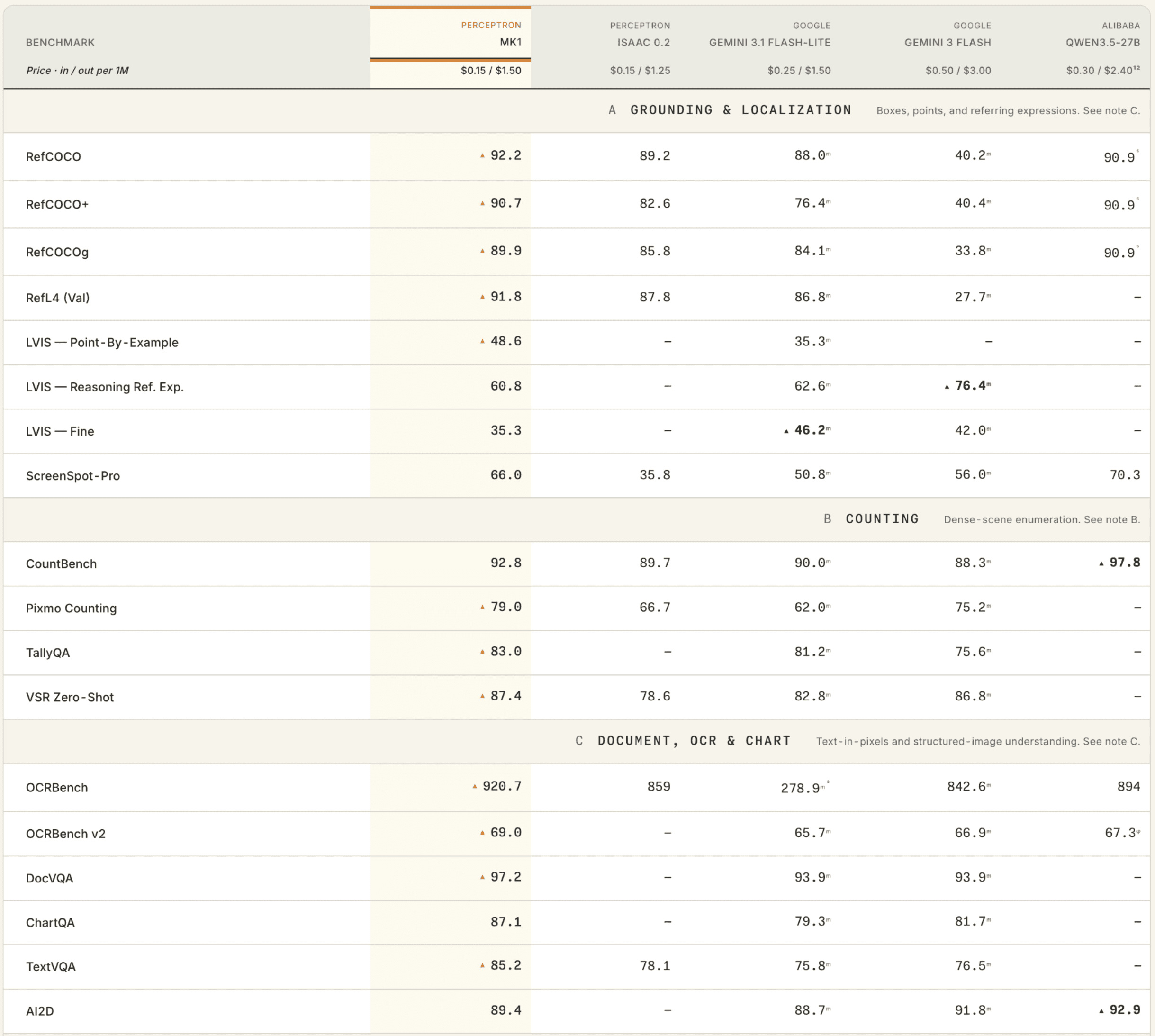
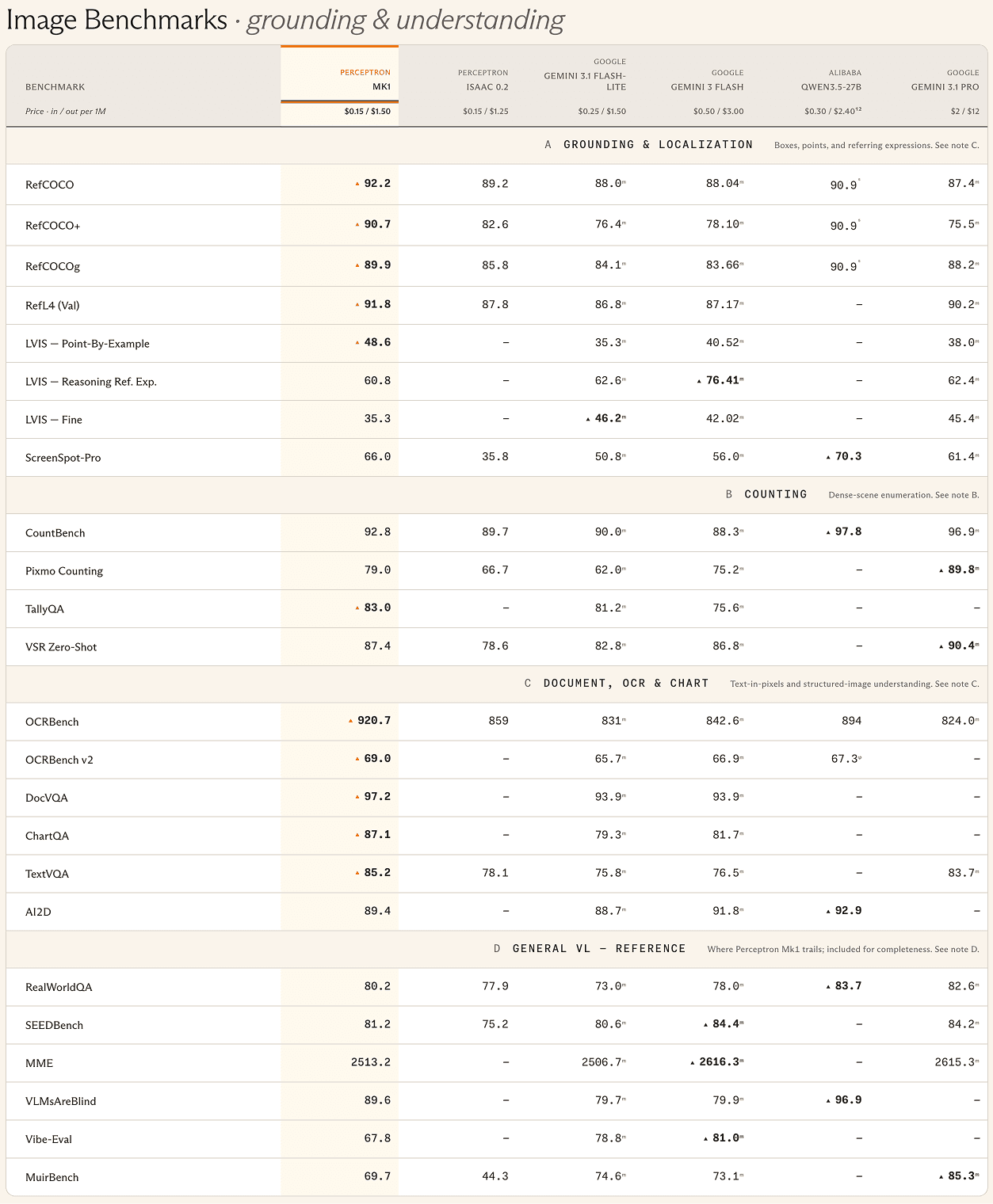
Pointing and counting. Mk1 points more accurately, solving tasks like hand pose estimation. It also counts reliably into the hundreds, including dense scenes (e.g., parking lots, parts on a tray, inventory on a shelf) where prior models plateau or guess.
Complex OCR and instrument reading. Mk1 reads messy text, analog devices, and digital instruments accurately, including precise hour and minute hand placement on standard clock faces and needle positions on gauges. This unlocks meter reading, dashboard monitoring, and legacy industrial control room digitization.
Structured document extraction. Mk1 converts complex documents to HTML, JSON, or Markdown with layout, tables, and hierarchy preserved. It handles the hardest cases (multilingual text, dense tables, handwritten annotations) where most models lose structure or drop content entirely.
Performance
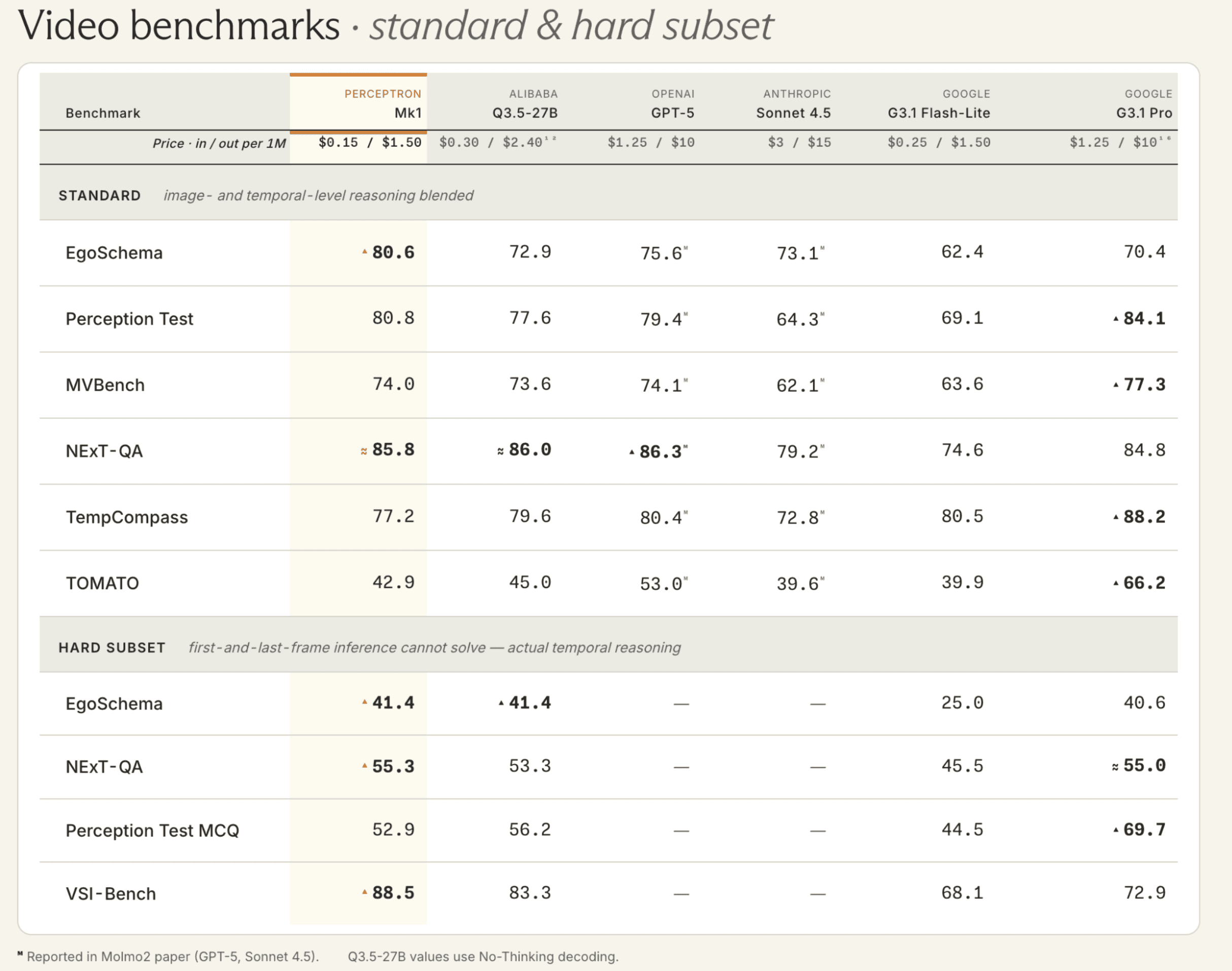
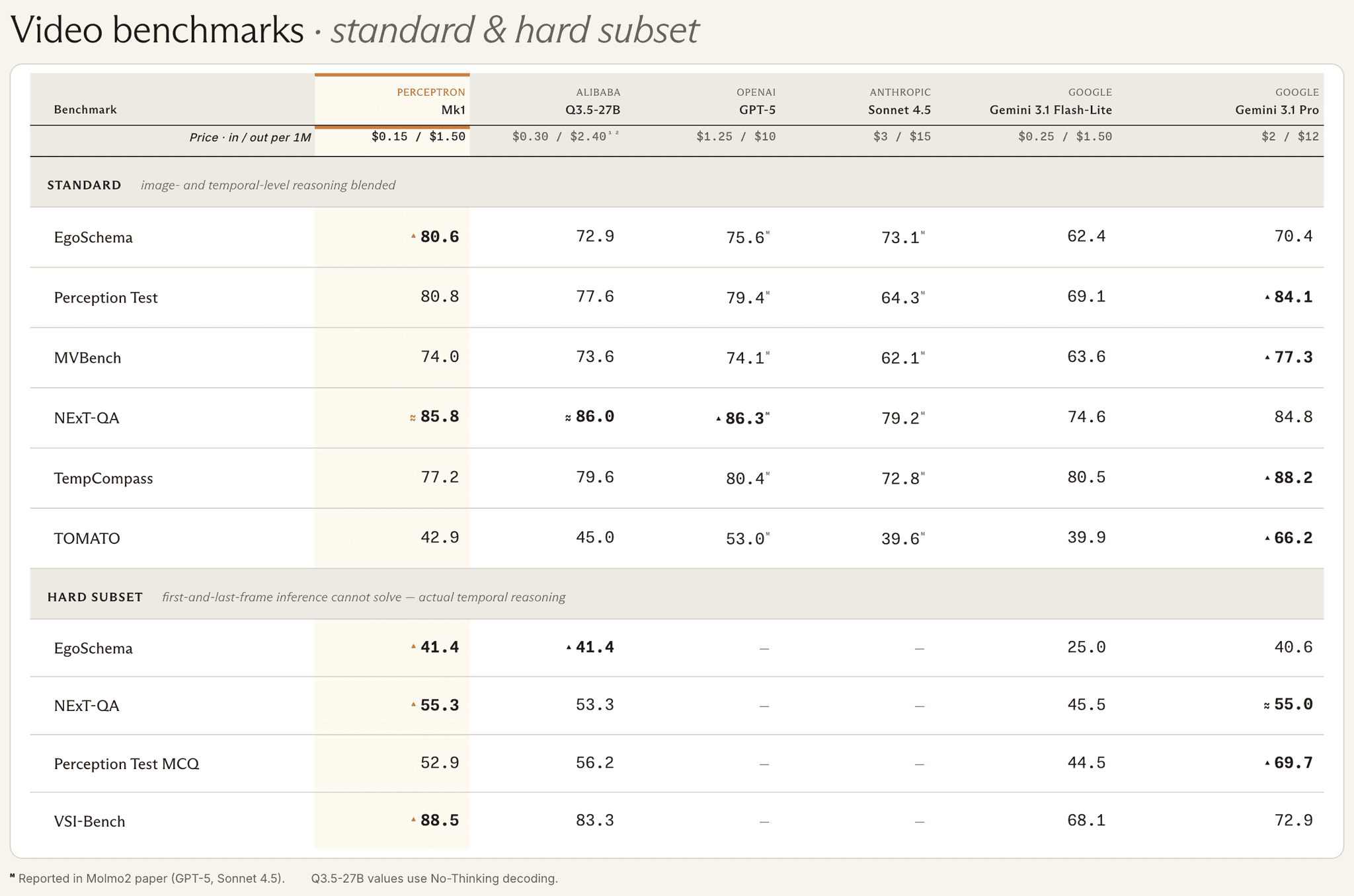
Mk1 matches frontier models from Google, Alibaba, OpenAI, and Anthropic on video and embodied reasoning, while operating at significantly lower cost.
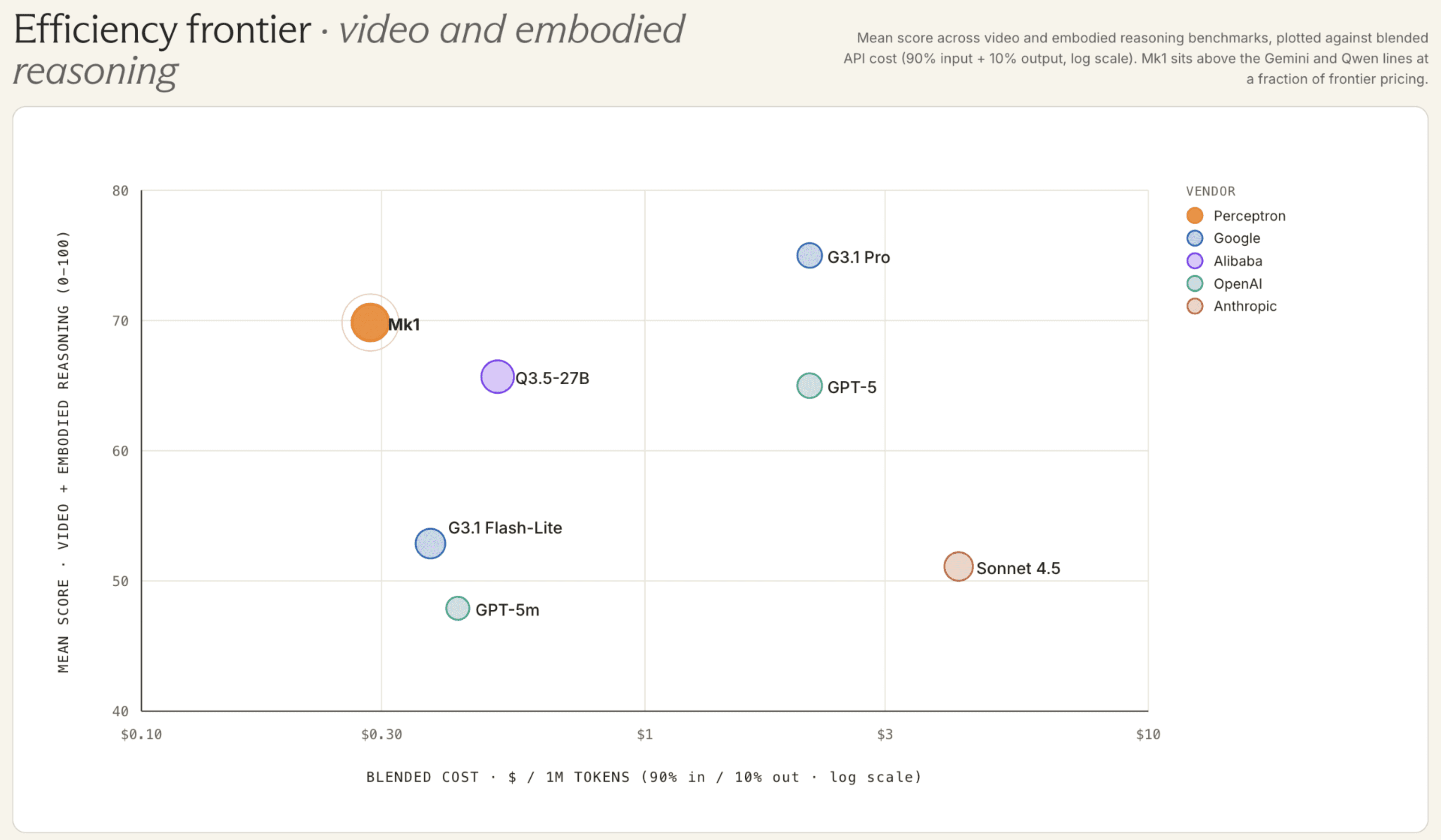
Scope: Embodied Reasoning table + video table below (standard + hard subset). The general-VL/reference table is excluded so saturated VQA scores don't dilute the signal.
Not plotted: Robotics-ER 1.5 (no output price) · CosmosR2-32B (open weights) — blended cost is undefined.
Note: Bubble size = n. Frontier models with n < 5 (Opus 4.5, GPT-5m) are noisy single-point estimates; treat their position as indicative, not definitive.
Video Benchmark Results
Embodied Reasoning Benchmark Results
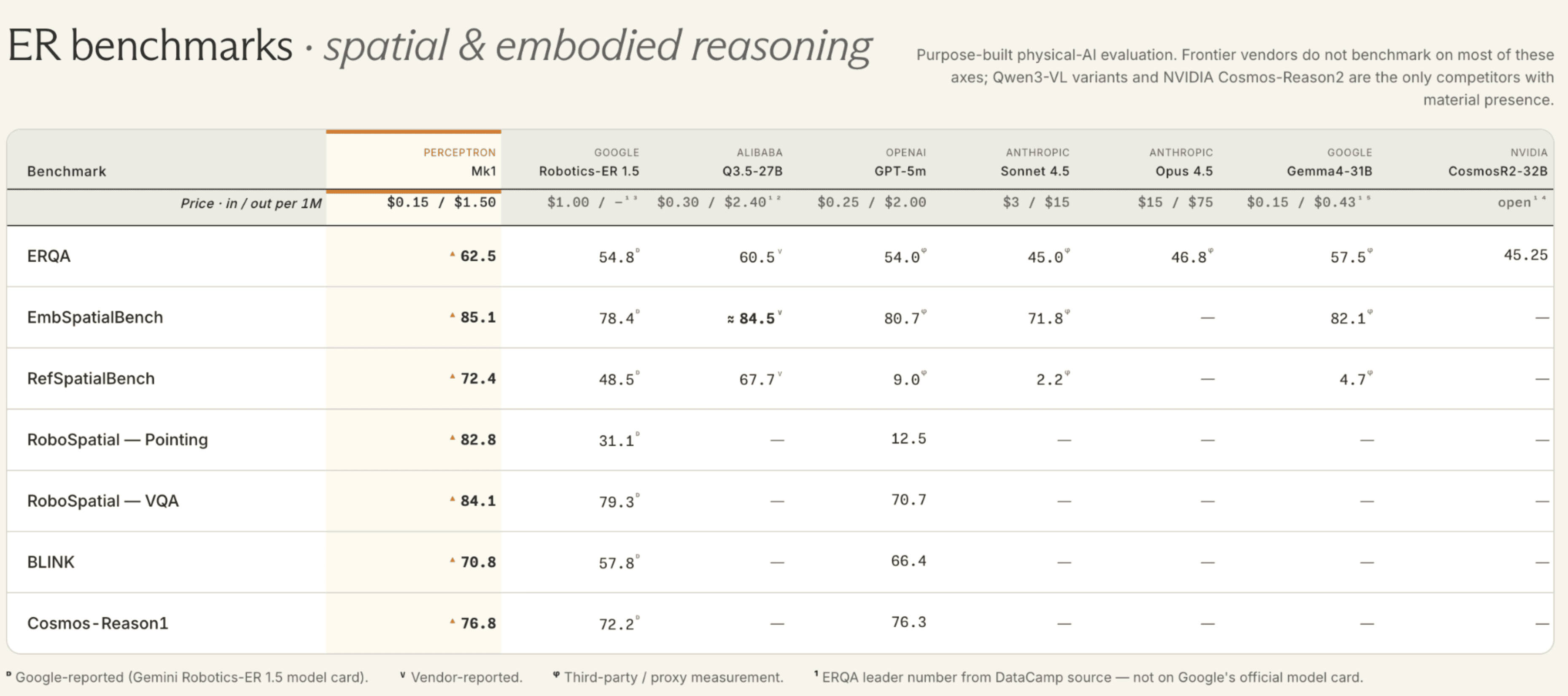
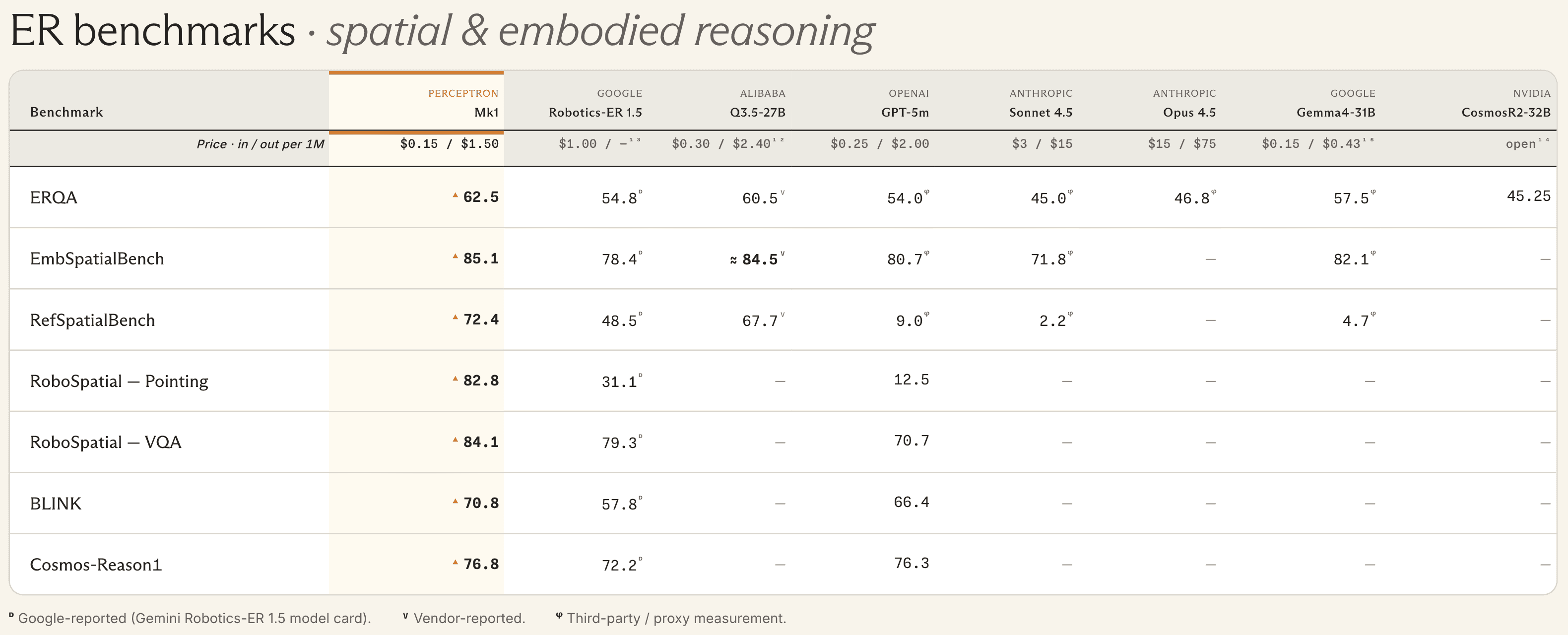
Image Benchmark Results
Powering the Robotics Stack
As shown in the benchmarks, Mk1 is a frontier embodied reasoning model. It points with pixel precision, holds object identity across frames through occlusion, reasons over multiple camera streams jointly, and reads task outcomes directly from video.
Mk1 is trained with structured spatial primitives (i.e., point, box, polygon, track, clip) as first-class outputs alongside text, so a downstream model or policy can consume them directly. This makes it useful at multiple stages of the AI robotics stack.
Training the next policy. Mk1 turns raw teleop footage into supervised data for the systems that come next. Subtask boundaries for hierarchical VLAs. Success and failure labels for reward models. Action-conditioned annotations for world model training. Quality scores for episode filtering. The annotation pipeline that used to require a team of humans runs as one prompt.
Running alongside the VLA. At inference, Mk1 sits above the policy. It returns grasp affordances, constraint checks, and relational targets (“the pallet closest to the loading bay”). It tracks the same object across wrist, overhead, and scene cameras. It reads outcomes from video as a retry-or-progress signal, no separate critic and no separate grounder. The same model can verify a VLA’s output, condition a world model’s rollout, or close an RL loop.
Real-World Applications
Mk1 is built for production environments that depend on reliable visual understanding. Six deployment archetypes drive most of what our partners build today:
Manufacturing and industrial. Operational analytics and safety monitoring across factories, construction sites, and warehouses. Detect product defects, flag OSHA violations in real time, read analog instruments on inspection rounds, and learn new defect classes from a handful of examples without fine-tuning.
Media and content. Semantic visual search, tagging, and policy enforcement at scale. Auto-clip highlights from live sports, surface the right shot across hours of film and TV footage, and moderate AI-generated content on social platforms.
Robotics and automation. Onboard embodied reasoning for manipulation and navigation: pointing for grasps, multi-view understanding across cameras, success detection on task attempts. Offline, curate teleop episodes into structured training data without human annotators in the loop.
Geospatial and critical infrastructure. Satellite, drone, and fixed-camera analysis for utilities, construction, and insurance. Detect vegetation encroachment on power lines, monitor oil rig and bridge anomalies, track construction progress, and assess post-disaster damage for claims.
Security and surveillance. Real-time intelligence across home and enterprise cameras. Surface context-aware alerts that separate meaningful events (package deliveries, retail theft, intrusion, queue buildup) from background activity.
Devices and multimodal agents. Enhanced vision for Claude, Codex, and other text-first agents. Assess documents, sort files, automate desktop and browser tasks, and enable real-time scene understanding on glasses and headsets.
Getting Started
Mk1 is available today via the Perceptron Platform and our updated SDK.
Context Window: 32K tokens of multimodal context
API Model ID: perceptron-mk1
Pricing: $0.15/M input tokens | $1.50/M output tokens
Context Window: 32K tokens of multimodal context
API Model ID: perceptron-mk1
Pricing: $0.15/M input tokens | $1.50/M output tokens
Context Window: 32K tokens of multimodal context
API Model ID: perceptron-mk1
Pricing: $0.15/M input tokens | $1.50/M output tokens

The Road Ahead
Mk1 makes frontier video and embodied reasoning deployable, not theoretical. It's the foundation for a new class of physical agents: systems that see, reason, and act in the world they're embedded in.
Our partners are already deploying these agents across manufacturing lines, robotics fleets, content platforms, and security networks, solving physical-world tasks where general-purpose models still fail.
The next releases in our Perceptron model family will push further on three axes: temporal reasoning across longer horizons, action-grounded video understanding for embodied agents, and cost efficiency. Robotics sits at the center of this roadmap.
The goal is the same one we started with: physical intelligence, deployable everywhere it's needed.